| |
Architectural
Design of a Traditional Kalari
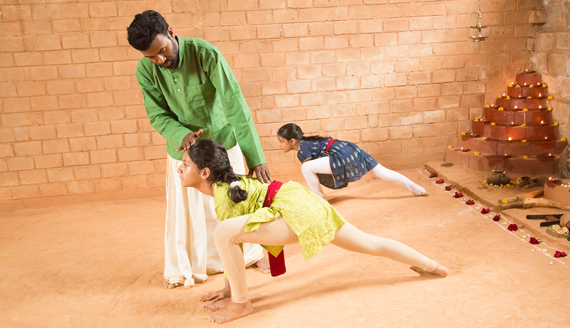
The art is trained in an enclosure called ‘Kalari’, which is
21 feet by 42 feet. The entrance faces the east. In the
south-west corner is a seven-tiered platform called the "poothara",
which houses the guardian deity of the kalari. These seven
steps symbolise seven abilities each person requires. They
include Vigneswa (Strength), Channiga (patience), Vishnu
(commanding power), Vadugashcha (the posture), Tadaaguru
(training), Kali (the expression) and Vakasta - purushu
(sound).
Other deities, most of them incarnations of the Bhagavathi or
Shiva, are installed in the corners.
Origin and Evolution
Kalaripayattu is perhaps the most ancient martial art in the
world. Religions have incorporated Kalaripayattu into their
realm. The origin of Kalaripayattu is still in the midst of
obscurity. Traditional Kalari masters attribute mythological
stories and legends to the origin of the art. Legend traces
the 3000-year-old art form to Sage Parasurama- the master of
all martial art forms and credited to be the re-claimer of
Kerala from the Arabian Sea.
At the turn of the 6th century A.D., martial arts spread from
Southern India to China by Daruma Bodhidarma - an Indian
Buddhist monk and Kalaripayattu master. From China, martial
arts have spread to Korea & Japan. Kalaripayattu is derived
from the words Kalari - which means "place, threshing floor,
or battlefield", and payattu - which means to "exercise in
arms or practice".
Martial arts have been in existence on the Indian
sub-continent for thousands of years. Long ago, animal
fighting styles were imitated by pre-historic man which was a
system for survival. The first weapon used was the stick which
was an extension of the arm. Various weapons were later
invented during the Stone and Iron Ages. Even in Vedas they
have mentioned about martial arts. Kalaripayattu is one such
martial art, Crafted in ancient South India and draws
inspiration from the raw power, majestic strength and
instinctive fighting techniques of animals like lion, tiger,
elephant, wild boar, crocodile etc.
It is significant that some Kalaripayattu masters trace their
lineages of practice to "Dhanur Veda" and claim that the texts
in which their martial techniques are recorded derive from
Dhanur Vedic texts. Although the Dhanur Veda means the
"science of archery," it encompassed all the traditional
fighting arts. The explicit concern in Dhanur Veda texts is
not with battlefield strategies, but rather with training in
martial techniques.
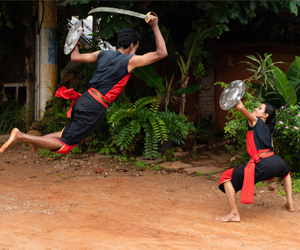
The Dhanur Veda opens by cataloging the subject, stating that
there are five training divisions (for warriors on chariots,
elephants, horseback, infantry, or wrestling), and five types
of weapons to be learned (those projected by machine [arrows
or missiles], those thrown by the hands [spears], those cast
by hands yet retained [noose], those permanently held in the
hands [sword], and the hands themselves [249:1-5]).
Most of the final Chapters are brief descriptions of postures
and techniques for wrestling and the use of a variety of
weapons including noose, sword, armors, iron dart, club,
battle axe, discus, and the trident. A short passage near the
end of the text returns to the larger concerns of warfare and
explains the various uses of war elephants and men. The text
concludes with a description of how to appropriately send the
well-trained fighter off to war.
Kalaripayattu reached its pinnacle of glory during the
100-years-war between the Cholas, Cheras, and Pandyas in the
early part of the first millennium. The warring states refined
the fighting skills and techniques prevalent in the area into
a martial art form. The art flourished between the 13 and 16
centuries, becoming a part of the education of youngsters. It
was a social custom in Kerala to send all youngsters above the
age of seven to learn Kalari.
The inherent beauty of this art form lies in the harmonious
synergy of art, science and medicine. The various movements in
Kalari are based on animal movements. Several poses are named
after animals. Hence it is generally believed to have
developed in the jungles when hunters observed the fighting
techniques of various animals.
The death blow to the Kerala military system and Kalaripayattu
was dealt by the British. When the Malabar Province was ceded
in favor of the British by the treaty of Seringapatam in 1792,
there were a series of revolts in Malabar. The revolt led by
Pazhassi Raja was well supported by the Nair soldiers and
Kurichya tribals of Wayanad. The British dreaded the
widespread Kalari training and objected to the traditional
system of carrying arms by the Nairs. Thus the Malabar
commissioners found it essential to unarm the entire region to
establish tranquility. Major Dow's direction in this regard,
is note worthy.
On 20th February 1804, Robert Richards, the Principal
Collector of Malabar, wrote to Lord William Bentinck,
President and General-in Council, Fort. St. George, asking
permission to take action against persons carrying arms,
either imposing death penalty or deportation for life. Lord
Bentinck issued an order on 22nd April 1804, that those who
concealed weapons or disobeyed the orders of the British
against carrying arms would be condemned to deportation for
life.
At the time of the Pazhassi rebellion, British soldiers raided
each and every house of the rebels to confiscate their arms.
The same situation repeated in Travancore at the time of the
revolt orchestrated by Veluthampi, the Dalawa of Travancore.
These developments led to the slow deterioration of
Kalaripayattu. Yet, there were a few Kalaripayattu gurus who
worked selflessly to keep this tradition of martial art alive
for the future generations by training youngsters away from
the prying eyes of the British rulers.
Kalari's influence on other arts
Kalaripayattu has strongly influenced the evolution of several
of Kerala's theatre and dance forms, most prominently
Kathakali and Theyyam. Kathakali practitioners are required to
train under Kalari masters to develop various attributes such
as fitness, stamina, and martial movements enacted in their
performances. Kalari practitioners claim that Bodhi Dharma, a
Buddhist monk who was responsible for training the Shaolin
monks in kung-fu, was in fact a Kalari master.
Resurgence of
Kalaripayattu
|
|