|
Beginners Level
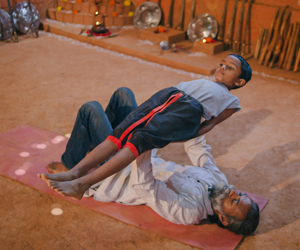
- Understanding Stance and Structure.
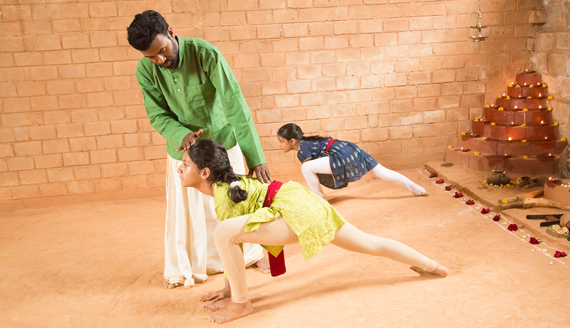
This is a prerequisite session for beginners in Kalaripayattu
and usually stretches for three months. It introduces body
conditioning exercises, stretching, basic hand and leg
techniques, stances, and stepping. This exposure gives the new
member a better foundation in order to enter into the advanced
level in Kalaripayattu and focuses on achieving the skill to
adopt certain stances which are broadly classified into two -
'Chuvadu and Vadivu'. Chuvadu is a position of the feet while
Vadivu is a position of the posture of the body, keeping the
chuvadu as its basis.
Duration: Two months.
Timings for Beginners Classes
Batch 1 Tuesday and Thursday morning 7.00 to 8.30
Batch 2 Monday and Wednesday evening 7.00 to 8.30
Timings for Weekend Classes
Batch 3 Saturday and Sunday morning 7.00 to 8.30
Batch 4 Sunday 6.00 to 7.30 evening and Saturday 7.00 to 8.30
evening
Contact
Us for a
free Kalari trial class.
Second Level
After the completion of the first level a Kalaripayattu
trainee graduates on to Meipayattu (meaning the use of body).
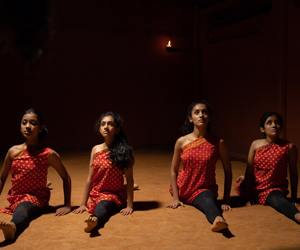
It is a series of exercises, in 18 different lessons designed
to achieve peak physical fitness and flexibility of the body.
They include specific exercise for legs, hips, hands and the
torso.
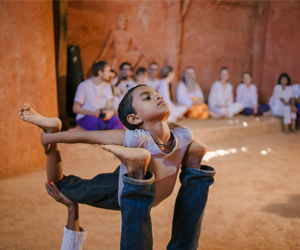
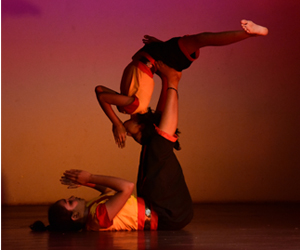
In the second level, the training includes acrobatics,
different types of flips and kicks.
Weapon Combat
This is a supplementary program for members interested in the
practical use of martial arts. Training in weapons begins at
the intermediate level, when there is a better understanding
of the mechanics of movement and improved coordination. A
weapon becomes an extension of one's body and a further test
of one's skill. This supplementary program enhances the
understanding of the principles and concepts in martial arts
and ultimately develops better execution in all movements.
Weapons are taught in form sequences to responsible
individuals.
The training with weapons commences with cane weapons; the
trainee graduates to using the Short Stick (Cheruvadi), Curved
Stick (Ottakkol), Mace (Gada), Dagger (Kattaram). Once the
dagger fighting has been mastered, the trainee starts on the
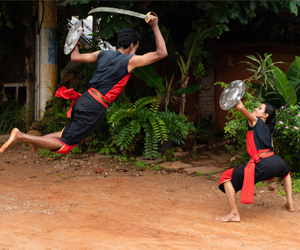
most glamorous of combats in kalaripayattu - fighting with the
sword and shield. Finally Urumi (six feet length flexible
sword) - is taught as the fitting finale to perfection in the
art of Kalaripayattu. This is the most dangerous weapon in the
Kalari system other than your own body.
Kalari Treatment
Kalari chikitsa or kalari treatment is an integral part of the
kalari tradition. It is mainly used to treat sprains,
fractures, cuts and similar injuries and was originally used
as a form of treatment for the trainee's injuries. Kalari
medication, with its own brand of potent oils, unguents and
different types of bandages, is also popular among the general
public.
The final training of a student includes in identifying the 64
Kula Marmas (deadly spots) in the human body.
CERTIFICATE COURSE
Kalari academy of performing arts offer certificate
course in Kalaripayattu, the Traditional Martial Art of India.
This programme is designed to meet the advanced interests of
the student of Kalaripayattu studies.
DURATION:
The duration of the programme shall be four semesters.
SYLLABUS:
Semester I
(a) Chuvadu: The initial training in kalaripayattu focuses on
achieving the skill to adopt certain stances which are broadly
classified into two - 'Chuvadu and Vadivu'. Chuvadu is a
position of the feet while Vadivu is a position of the posture
of the body, keeping the chuvadu as its basis. The
combinations of chuvadu and vadivu form the steps followed
prior to an offensive or defensive maneuver. Chuvadu training
stresses on various kinds of firm positioning of the feet.
(b) Vadivu: In vadivu, importance is given to the posture of
the body. The ancient masters codified eight types of vadivus
after watching the crouching attack positions of various
animals. The eight vadivus are: Varaha - Wild Boar, Gaja -
Elephant, Marjara - Cat, Simham - Lion, Sarpam - Snake,
Kukkuda - Cock, Mayura - Peacock and Haya - Horse.
(c) Leg Exercises: There are ten types of leg exercises
(kicks) are thought to each students.
(d) Meipayattu: Meipayattu meaning body in practice. It is a
series of exercises, in 18 different lessons designed to
achieve peak physical fitness and flexibility of the body.
They include acrobatics, different types of flips and kicks.
Semester II
(a) Short Stick (Muchan): This wooden weapon is about 1.5 feet
long (three span), mainly used for defense. It involves
powerful blows and blocks with speed.
(b)Long Stick (Kettukari): This is a form of combat using a
long cane stick, as tall as the trainee (5 ½ feet). This
combat contains mainly offensive movements.
(c)Dagger (Kattaram): The dagger is a double-edged, sharp
weapon made of tempered steel, with a length of about 1 ½
feet. This combat contains thrusts and blocks.
(d) Knife (kathipayattu): A smaller version of Dagger. It is a
small handy double edged weapon.
(e) Kaikuthipayattu: Advanced body training to improve ones
stamina, power and concentration.
Semester III
(a) CURVED STICK (Ottakol): This is a horn shaped weapon with
a knob at one end. The knob is used to attack the vital spots
of the nervous system.
(b) SWORD AND SHIELD (Vallum parichayum): The sword is used
for offence and the shield is used for defense. The most
important and advanced fighting with the sword and the shield
is called Puliyangam, the combat being likened to a battle
between leopards.
(c) SWORD AND SPEAR (Marapidichakuntham): One combatant is
armed with a sword and shield and the other with a spear.
(d) Udaval: This is the training in fight with sword. Attack
and defense are done by sword only.
(e) BARE-HANDED COMBAT (Verumkai): These techniques include
those that are used to disarm and disable an opponent.
Semester IV
(a) FLEXIBLE SWORD (Urumi): The Urumi is the most dangerous
weapon in the Kalari system. It is six feet in length,
flexible, and can be worn around the waist.
(b) Kalari Massage (Uzhichil): Uzhichil or a medicated massage
is used to make the body supple. It stimulates the nerves and
relaxes the muscles.
(c) Marmapoints : The final training of a dedicated student
includes training in Ayurveda and identifying the 64 Kula
Marmas (deadly spots) in the human body.
General Rules:
The students shall be required to secure a minimum of 70%
marks in each course in order to be eligible for promotion to
the next semester
A Faculty Certificate is issued on the successful completion
of each unit.
RESIDENTIAL CLASS
Kalari academy of performing arts introduces residential
classes in kalaripayattu for the beginners level.
Duration: four days, three hours each day.
Includes everyday
Full body kalari massage with medicated oils
for more details please
mail us
with your contact details
|